

Are Stablecoins a Safe Choice? Part 1: The Dark Side of Stablecoins

Let me announce that I won’t answer this question in this post, but in an upcoming one. This isn’t clickbait—rather, the answer wouldn’t be complete without discussing both the apparent and hidden risks of stablecoins, as well as what risks we ultimately need to understand and manage. We also need to consider what framework could be safe for our country. Instead, we’ll focus on the downsides of stablecoins and the ramifications of this innovation on both the macroeconomic and microeconomic levels. Finally, we’ll discuss whether a stablecoin can be considered sound money that we can use without worrying about any unpleasant surprises.
Stablecoins Are Just at the Beginning
To put things in perspective, the numbers are dizzying at first glance: an estimated annual transaction volume of $28 trillion in 2025. But when compared to major payment systems, the reality is more modest; this volume represents less than three weeks of settlements from the main U.S. wholesale payment systems, and total market capitalization was capped around $320 billion at the end of May 2026.
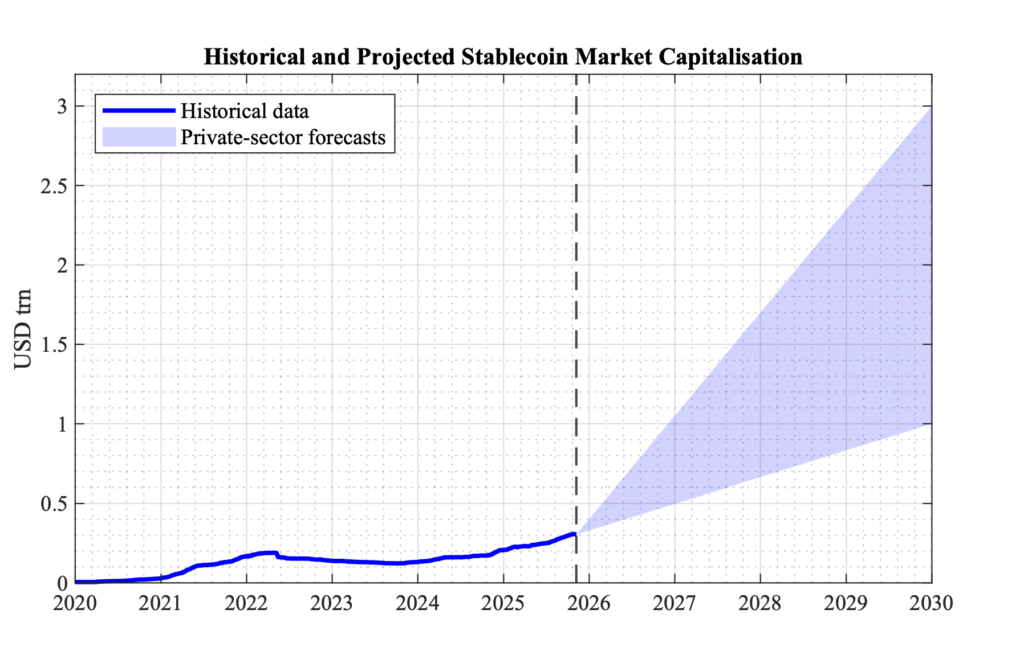
Their primary purpose is to combine the stability of traditional financial assets with the efficiency of blockchain technology, enabling instant global payments, inflation hedging in emerging markets, decentralized finance (DeFi), and the tokenization of financial assets. However, in practice, the vast majority of stablecoin activity today is driven by cryptocurrency trading, liquidity provision, and other DeFi applications rather than everyday payments.
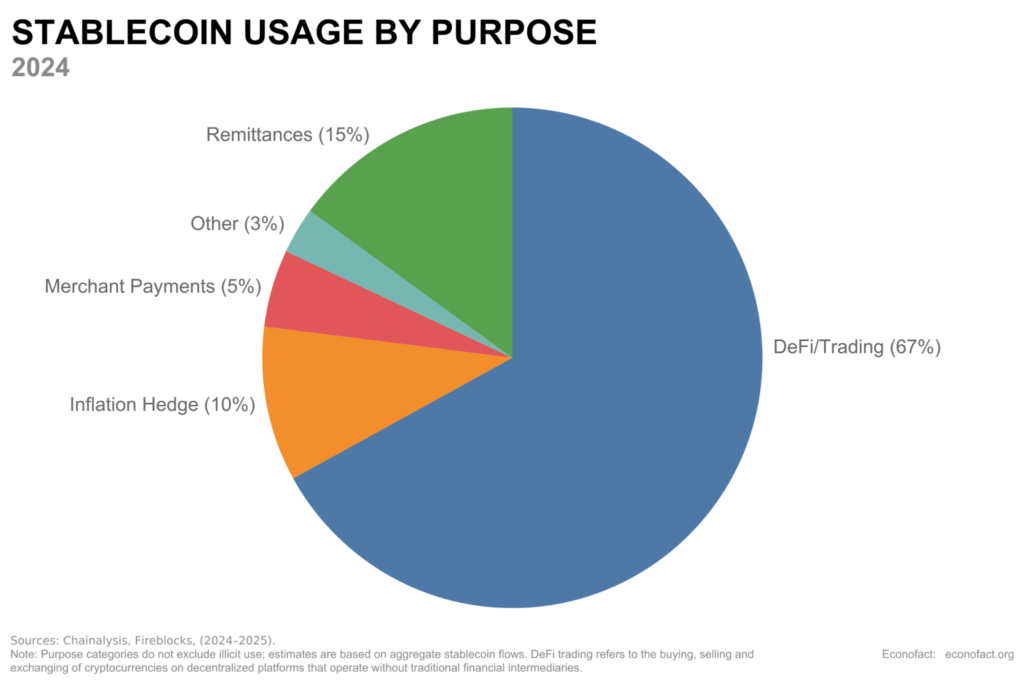
A sector that remains small compared to traditional finance, yet one whose structural flaws worry regulators and global financial bodies like the BIS and the ECB enough to raise concern.
The ECB warns that euro-denominated stablecoins could, in the future, weaken banks and erode the deposit base, knowing that bank deposits in the eurozone represent approximately €17 trillion, while the global stablecoin market weighs in at nearly $320 billion, in a climate where banks are already losing payment fee revenues and transaction data to mobile payment providers. The BIS, for its part, warns that stablecoins do not possess the fundamental characteristics of trustworthy money, presenting structural risks likely to threaten global financial stability and the monetary sovereignty of states.
Is It “Sound” Money?
To judge the robustness of stablecoins, one can evaluate several aspects and see how they differ from existing currencies or equivalent financial instruments:
Uniformity with Other Currencies
The uniformity of money, that is, the fact that different forms of money are interchangeable at equal value, also called the singleness of money, reflects its ability to be accepted at par without anyone questioning its form or origin. Concretely: one dollar or euro deposited at bank A must be worth exactly one euro deposited at bank B, without anyone needing to verify the soundness of one bank or the other before accepting a payment. This universal equivalence is made possible by final settlement in central bank money, which serves as a neutral common denominator between all commercial banks.
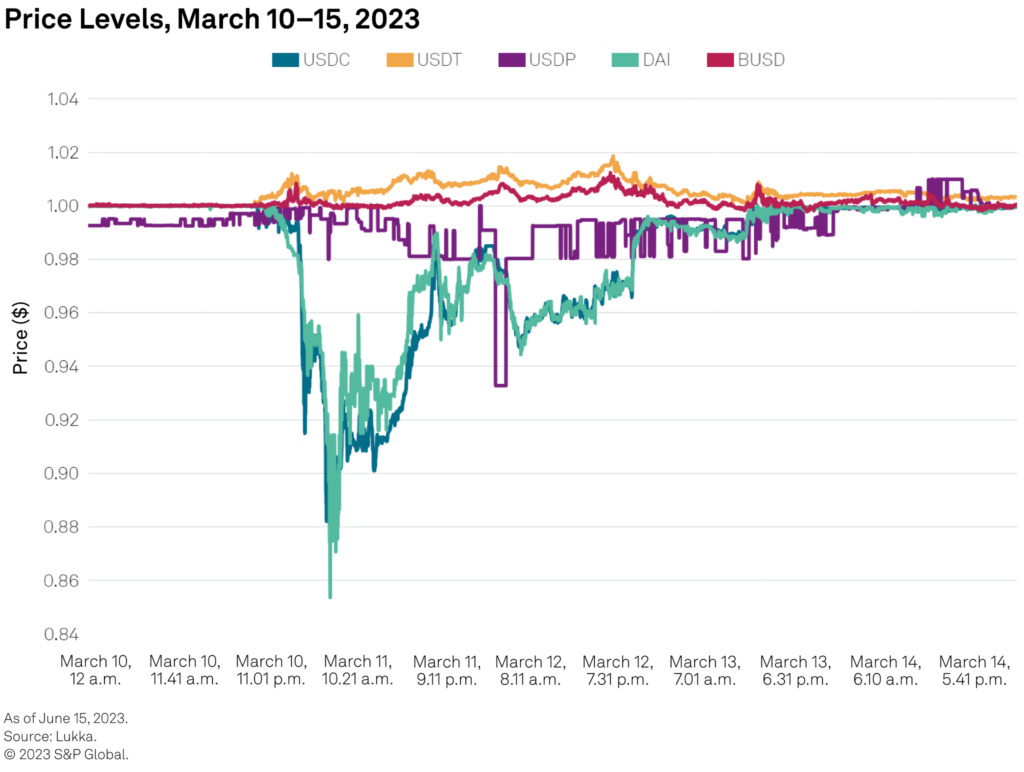
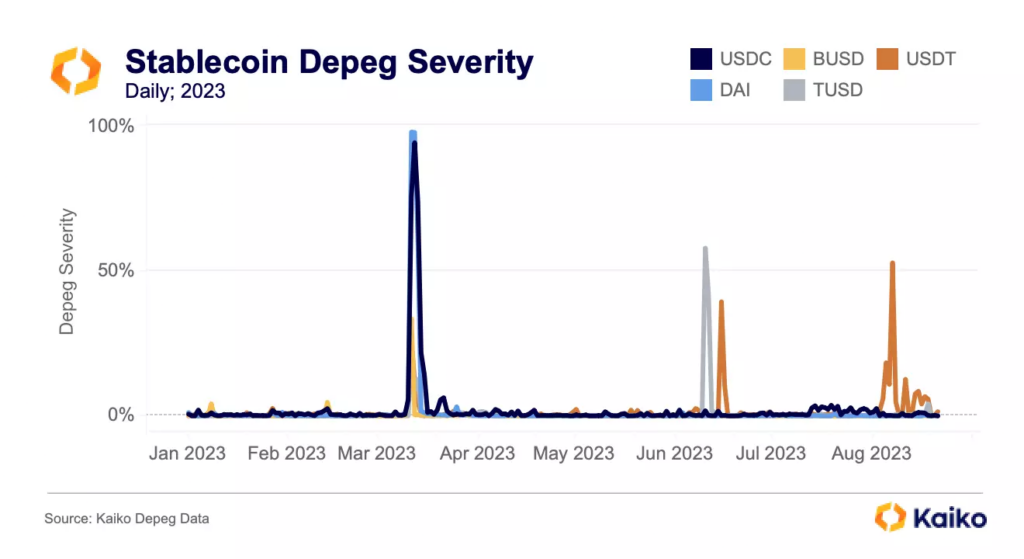
Stablecoins fail this test for a structural reason: each token carries, in a sense, the name of its issuer, much like the private banknotes issued by different commercial banks during the Free Banking era in the United States in the 19th century. A USDC is not guaranteed by the same entity, nor by the same reserves, as a USDT or a DAI; each is a distinct commitment from its issuer, with its own credit quality. A direct consequence: stablecoins frequently trade (especially during times of stress) at prices slightly different from their theoretical dollar peg, depending on the platform, available liquidity, or confidence in the issuer at a given moment, a phenomenon that runs counter to the very promise of “stability” of the product. USDC lost its peg for several days in March 2023 during the Silicon Valley Bank crisis, falling to approximately $0.88 on March 11, while USDT remained stable, and thus the uniformity even among stablecoins can break.
Rigidity of Stablecoins
The second test is that of elasticity: the capacity of the money supply to adjust flexibly to the demands of the economy, so that large-value payments can be executed without delay or congestion, without waiting for the prior receipt of funds. In the traditional banking system, the central bank ensures the rapid availability of liquidity and adapts to micro- and macroeconomic circumstances.
Stablecoins operate according to a radically different logic. A token like Tether’s USDT is backed by a nominally equivalent amount of assets: any additional issuance requires full and prior payment from the subscriber, imposing a “cash-in-advance” constraint. In short, the issuer cannot grow its balance sheet at will to meet a sudden liquidity need of the economy, unlike a bank, which can elastically expand or contract its balance sheet, within the limits set by prudential regulation. Stablecoins are therefore, by design, incapable of playing the liquidity shock-absorber role fulfilled by traditional bank money.
Interoperability
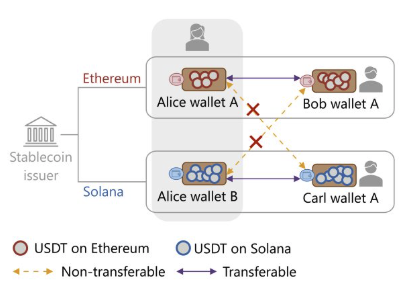
This criterion is self-explanatory. A single stablecoin issued on multiple different blockchains is not necessarily fungible without friction from one chain to another, which fragments available liquidity and complicates settlement, a flaw that mechanically aggravates the “singleness” problem, since the same token can, in practice, be worth slightly differently depending on the chain on which it circulates.
The Fragility of the Peg Mechanism and Stability
The very promise of the stablecoin: to maintain its value strictly aligned with the reference asset. But in practice, the redemption mechanism of major stablecoins brings them closer to an exchange-traded fund (ETF) than to a true currency, because convertibility at par is neither automatic nor guaranteed for all holders.
This observation is explained by an internal contradiction in the sector’s economic model: there is an inherent tension between the stablecoins’ promise of ensuring constant convertibility at par and the issuer’s need to generate a profitable business model, which almost always involves taking liquidity or credit risk on the reserves. This tension materialized spectacularly during the collapse of TerraUSD in May 2022, where an algorithmic stablecoin supposed to maintain its dollar peg through an arbitrage mechanism lost more than 99% of its value in a few days, dragging down tens of billions of dollars in savings in its fall.
The second flaw relates to the very composition of the assets that are supposed to guarantee the value of stablecoins. Issuers typically hold a combination of short-term government debt and bank claims, cash or repo agreements, and their holdings in U.S. Treasury bills have reached levels comparable to those of large jurisdictions or government money market funds.
This mass of reserves raises a dual question: that of the quality and real liquidity of the assets held in the event of a massive redemption, and that of the extreme concentration on a single currency. Approximately 99.4% of asset-backed stablecoins are pegged to the U.S. dollar, which exposes the entire ecosystem to the same market and liquidity shocks simultaneously.
It is in this light that the European Union and the United States have adopted regulatory frameworks to govern stablecoins, but with different approaches. MiCA (EU) requires issuer authorization, fully backed and audited reserves, of which at least 60% must be deposited in European banks, as well as redemption rights for holders. The GENIUS Act (United States) requires 100% reserves in liquid assets and establishes federal or state supervision depending on the size of the issuers. However, they do not benefit from any FDIC guarantee, consumer protection against fraud is deemed insufficient by some regulators, and the implementation of the framework remains incomplete.
Risks to Monetary Policy: Currency Substitution and Weakened Transmission
If stablecoins were to be widely adopted, the implications for monetary policy are profound, particularly in emerging and developing economies. A primary risk is currency substitution, where the adoption of foreign stablecoins (predominantly USD-based) drives a process of “digital dollarization.” This goes beyond merely holding a foreign asset; if stablecoins become widely used for pricing goods and services, taking on a unit of account role, they further displace the local currency’s function in the economy. Once established, dollarization has historically proven to be highly persistent. This decline in the usage of domestic money, which is under the central bank’s direct influence, directly erodes monetary sovereignty and seigniorage income.
The damage extends to the core of central banking: the transmission of monetary policy. Widespread use of stablecoins weakens the interest rate and liquidity channels, as currency substitution reduces the pass-through of policy rate changes onto domestic lending rates and economic activity. The credit channel is similarly impaired: as people shift deposits out of banks and into stablecoins, banks lose a stable funding source and reduce their intermediation activities. This can also alter interbank liquidity dynamics, potentially making interbank rates less sensitive to policy rates.
Finally, with significant money circulating in stablecoins outside official oversight, monetary aggregates become harder to measure and money demand becomes less predictable, severely complicating monetary policy planning.
Risk to private banks and emerging countries
The macro-financial risks extend far beyond monetary policy transmission. The BIS anticipates a set of implications potentially affecting credit supply, financial stability, and the fiscal space of states. Its simulations show that even at a capitalization of $1 to $3 trillion, the net effect on economic output would remain modest, while putting bank financing and credit under strain. This occurs as deposits migrate not to other commercial banks, but towards the reserves of stablecoin issuers, generating a process of financial disintermediation that erodes the deposit base (often already shallow in developing economies), raises funding costs, and constrains credit to the real economy.
A more specific risk concerns emerging countries. The rapid adoption of dollar-denominated stablecoins can induce more volatile capital flows. Faster, low-cost cross-border transfers, especially those outside the regulatory perimeter, can spur sudden capital outflows, amplifying volatility and potentially challenging foreign reserve management. Unregulated stablecoins can also circumvent capital flow management measures, such as exchange controls, undermining their effectiveness. Furthermore, heavy stablecoin usage may drain liquidity from local FX markets, making them shallower and more volatile, and potentially entailing short-term deviations from official exchange rates.
Beyond macro-flows, stablecoins introduce unwelcomed operational and counterparty risks. A collapse of a major foreign issuer, outside the local jurisdiction, could directly transmit instability into the local financial system.
The Absence of a Safety Net and the Multi-Issuer Vulnerability
Contrary to an insured bank deposit (where for instance in Morocco, the Société Marocaine de Gestion des Fonds de Garantie des Dépôts Bancaires (SGFG) insures eligible deposits of up to 800,000 MAD per depositor, per insured bank, per ownership category or up to 250,000$ by the FDIC in USA), a stablecoin benefits from neither a deposit guarantee nor access to a lender of last resort. In the event of a massive and simultaneous withdrawal, no institutional mechanism is planned to absorb the shock, a fragility that neither European regulation nor American regulation, however recent and ambitious, totally removes. A foreign stablecoin issuer lies outside the domestic jurisdiction entirely, making any form of coordinated rescue or liquidity provision practically impossible for national authorities.
As the ECB’s head has recently highlighted, the risk is compounded by the growing complexity of multi-issuer schemes. Where the same stablecoin is issued jointly by EU and non-EU entities, MiCAR’s safeguards reach only the EU issuer. In a run scenario, investors will naturally seek to redeem their holdings where protections are strongest, which is likely to be the EU, where MiCAR also prohibits redemption fees. But the reserves held in the EU may not be sufficient to meet such concentrated demand. The danger, as the ECB warns, is known: a regulatory framework that covers only part of an issuance structure can create a false sense of security, while leaving the door open to precisely the kind of run dynamics that the regulation was designed to prevent. We do not need to wait for a crisis to recognize and address these structural weaknesses.
Conclusion
Stablecoins offer real technological advantages: speed of transfers, programmability, continuous availability. But on a structural level, they fail the fundamental tests that define trustworthy money, guaranteed parity, quality of reserves, interoperability, financial integrity, and the existence of a safety net in the event of a crisis. The two major regulatory responses provided to date, MiCA in Europe and the GENIUS Act in the United States, constitute real advances in terms of transparency and issuer governance, but neither solves the fundamental problem: the absence of a public guarantee comparable to that enjoyed by bank deposits. As the IMF has highlighted, the risks to monetary policy transmission, financial stability, and monetary sovereignty, especially via digital dollarization, add a layer of systemic danger that no private issuer can resolve on its own. And as the ECB has made clear, even where regulation is in place, its effectiveness can be undermined by cross-border issuance structures that leave critical gaps in the safety net.
On the other hand, tokenized commercial bank deposits represent another promising avenue. Issued by regulated institutions, they benefit from the credit quality of these institutions, can circulate on distributed ledger technology (DLT) platforms, and could, in time, establish themselves as a more suitable alternative than stablecoins for many wholesale use cases.
CBDCs can also play the role of core payment infrastructure, helping to mitigate some of the risks associated with stablecoins. Recent developments show that this approach is now feasible. As an example, the Pontes project enables wholesale settlement by linking DLT platforms to TARGET, the Eurosystem’s existing settlement system, thus ensuring that DLT-based transactions can be settled in central bank money from day one. These public or bank-based alternatives may well prove to be the credible path towards a truly sound digital money.
Lastly, we should not fall into the trap of evaluating stablecoins only under normal market conditions. They may be an important innovation that performs well during periods of stability, but their true resilience is revealed during periods of financial stress. More rigorous stress testing is needed to assess how resilient, reliable, and robust they remain under adverse market conditions.
references :
1 https://www.bis.org/publ/arpdf/ar2026e3.htm
2 ssrn
3 https://www.imf.org/-/media/files/publications/wp/2026/english/wpiea2026129-source-pdf.pdf
4 https://www.newyorkfed.org/medialibrary/media/research/staff_reports/sr1185.pdf
5 https://download.ssrn.com/2026/6/4/6880061.pdf
6 https://www.kcl.ac.uk/business/assets/pdf/single-minded-final.pdf
7 https://papers.ssrn.com/sol3/papers.cfm?abstract_id=6438962
8 https://www.imf.org/en/-/media/files/publications/dp/2025/english/usea.pdf